Available in Israel
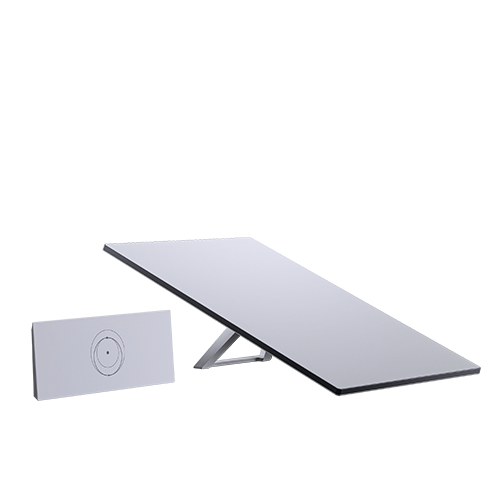
Business Standard Kit
A business kit for primary or backup connectivity, in offices and at remote sites.
- Download40-350 Mbps
- Upload8-30 Mbps
- Latency20-40 ms
- IP ratingIP67
We supply the kit, install it on site and integrate the line into your network - as a primary connection or as automatic failover.
Starlink sits alongside fiber. It covers sites outside the terrestrial footprint, deployments that have to be live in days, and the independent path an organisation needs when the ground network is cut.
The satellite link sits ready, monitored and tested. When the primary line drops, traffic moves to it within seconds, against the router or firewall already on site. The switch is automatic, with nothing to do on site - and we test it during installation.
A quarry, a solar farm, a construction site or a facility in the Arava: anywhere a wired rollout would take months and cost more than the site can justify. The survey picks a spot with open sky and a power feed, and the line connects to the control equipment on site.
An event, a build site, an interim office or an emergency centre. Full connectivity within days, and a clean teardown at the end of the deployment. The mount goes on a pole or a container roof, and the site has a link the day it is installed.
When the national communications infrastructure is congested or damaged, a path that does not run through it keeps the organisation working. Critical bodies keep one for that reason.
We bond the satellite link into your SD-WAN through Peplink SpeedFusion, so it is part of the network and its policy. In the portal every site sits under one account, with a map and data usage per line.
The satellite link appears in the same dashboards and the same alerts as the rest of the network. If it drops we get an alert, including when it is only the backup. An organisation that wants the data in its own systems gets an API for line status, data usage and billing.
Two kits are available for business in Israel - Standard and Mini. Both use an electronically steered phased-array antenna, with no moving parts. The kit, the data package and the installation come together. The heavier Performance line is not available in Israel.
The Standard is a 594 mm panel with a separate Router 3; the Mini is 298 mm with the router inside the dish, weighs one kilogram, and can be powered from USB-C. For almost every fixed business site, the Standard is the answer.
The Standard kit's Router 3 gives two LAN ports, or can be bypassed entirely so the link connects straight to your own firewall and becomes one WAN among several.
A business kit for primary or backup connectivity, in offices and at remote sites.
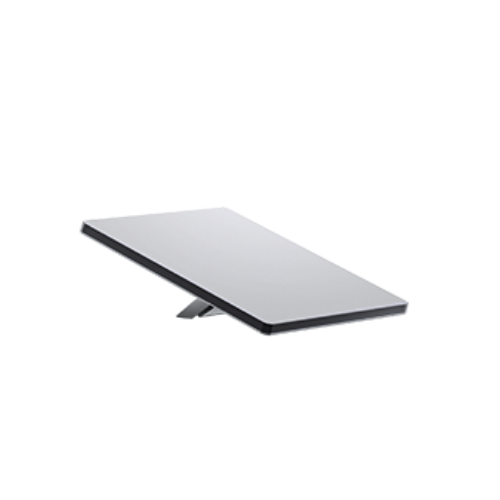
Compact kit with the router built in, for quick setup on site.
Typical performance. Actual speeds and latency may vary based on location, network congestion, and environmental conditions. Bonding the line with another link - through SpeedFusion or the equivalent on the router already on site - is supported where the site calls for it.

Built for demanding enterprise environments that need sustained throughput and a stable link.

The previous Performance generation, for existing deployments and controlled enterprise environments.

Performance kit for high-traffic sites and multi-site deployments.
Every kit comes with a monthly package. What we sell in Israel is the Local Priority service with a priority-data package. Starlink publishes no Israeli business pricing, so this page quotes none - the price comes in a quote.
Priority service for business sites in Israel. You choose a priority-data package; that data moves at the front of the queue. When it is spent, the line keeps running on unlimited standard data at lower priority - it slows under load, it does not stop.
For a site where the satellite link only carries traffic when the terrestrial line is down.
For a small team at a single site - mail, cloud and video calls.
For a site whose whole working day runs over this link.
For a traffic-heavy site, or several teams sharing one link.
Starlink's plan for global and ocean coverage - the maritime and cross-border option, with a data price Starlink keeps consistent worldwide. Not yet offered in Israel.
These are the figures Starlink publishes for Priority plans in its own specifications table, and they are global rather than Israeli. Speeds are not guaranteed and vary with location and load.
Priority plans include a publicly routable IPv4 address, and Starlink assigns it by DHCP. IPv6 is on by default. If a service behind the link needs a fixed address, we handle that at the firewall.
The quote settles one of three plans: Basic, Gold - support in business hours, 09:00-18:00, and Premium - 24/7 support. All of them are remote support; an on-site technician visit is charged separately. One support plan covers up to 2 antennas, on the Gold and Premium plans.
Portal access is included in the support plan, in all three of them. The portal shows every line in the organisation and its usage against the package, performs operations on the antenna and opens a service call.
Starlink gives priority data precedence over residential traffic on the same cell. Unused priority data does not carry into the next month, so the right package size matters.
When the priority allowance is spent, the line continues on unlimited standard data at lower network priority for the rest of the month. On a quiet cell the difference is barely noticeable; at peak hours it is clear. We size the package to the site's real usage.
Standby Mode, which lets a residential customer pause a line for a quiet season, is not available on business lines. A seasonal site is handled by choosing the package size.
Starlink states on its Israeli help centre that Roam and in-motion use are not permitted in Israel, for local regulatory reasons. The in-motion capability that exists elsewhere is therefore not something we sell here.
You can also order directly in the portal, and get a price for the kit, the package and the support plan you choose.
Order now

The portal is the same system SpotNet's operations team works in, on the same data and at the same time.
Every site on one map, each with its status.
Usage against the plan, service plan and address.
Live graphs per antenna.
Open a call against a line and follow it.
Where each order stands, from approval to live.
A recording of the portal itself. It lives at portal.spotnet.co.il.
Open the portal Installed by SpotNet's own crews
One supplier and one invoice for the hardware, the installation and the support.
Start with a site checkYou choose the kit, the data plan and the support plan in the quote. We plan how the link joins your existing network - hybrid WAN, automatic failover and routing policy.
After the order is confirmed an engineer comes to the site, checks the clear view of sky, maps obstructions and picks the right place for the antenna.
Our own crews mount the antenna, run cables, ground the system and integrate it into your existing network.
24/7 monitoring, real-time alerts and the support plan agreed in the quote. The portal shows uptime, throughput and latency per line.
A dedicated Starlink number at SpotNet, for questions before a quote.
Call 03-644-1010Five sites, each with a primary link and a backup drawn from fiber, 5G and Starlink. When a link drops, traffic moves onto the backup within seconds. Below, the difference under load between priority data and standard data.
Questions that come up before ordering Starlink for a business.