

A backup line, from planning to switch-on

A business that runs on cloud applications, telephony and payment terminals needs to know which path carries on when the primary line fails. A satellite link is a separate path: the antenna connects to satellites in low orbit, and they pass the traffic to ground stations connected to the internet.
Latency is measured in tens of milliseconds: 20-40 ms on the Business Standard kit, by the figures Starlink publishes. That suits video calls, VPN and work in cloud applications.
Three things planning decides
- 01
Where the antenna goes
It needs an open view of the sky and a power feed. The site survey maps trees, walls and poles that can cause short drops, and picks the position accordingly.
- 02
Where it joins the network
The link connects to the site's router or firewall beside the primary line, and when that line fails the traffic moves over within seconds, automatically. Where the session has to survive the switch, the lines are bonded with Peplink's SpeedFusion.
- 03
The monthly allowance
On a SpotNet business line all of the monthly allowance is Priority Data. When it runs out the line continues at a reduced speed of up to 1Mbps until the next cycle, so it is worth deciding in advance which services use the backup.
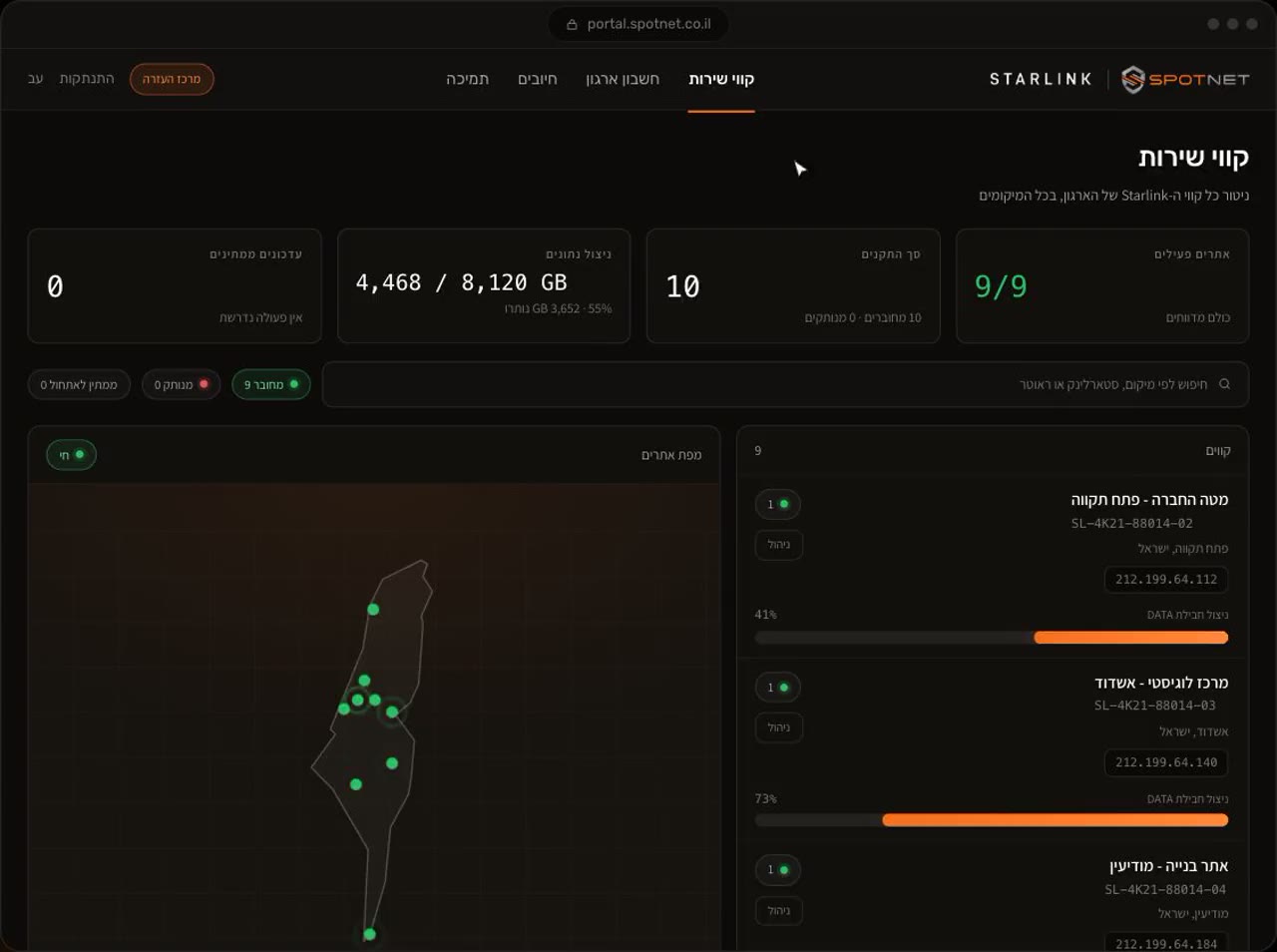
What is available in Israel
Two kits are available in Israel, Standard and Mini, and the service is for a fixed site. SpotNet installs nationwide, within about 7 business days, after a site survey.
Five questions before choosing a backup line
- Which services have to keep working when the primary line fails?
- How much traffic do those services use in a working day?
- Where does the primary line enter the building, and where does the second one?
- Who receives the alert when the backup takes over, and at which hours?
- When was the switch between the lines last tested?
Fortinet is back to the NSE names

On 15 July 2026 Fortinet's certification program returned to eight levels, NSE 1 to NSE 8. FCF, FCA, FCP, FCSS and FCX, in use between 2023 and 2026, are the former names of the same program.
NSE 4 takes one exam, Fortinet NSE 4 - FortiOS Administrator, and is valid for two years. NSE 5 and NSE 6 each require one further exam on top of an active NSE 4.
SpotCloud, and SASE from Israel


Starlink for business, in Zman Avir
 Open
SpotNet expands its Starlink offering in Israel
A managed satellite line for businesses, with the option to integrate it into the organisation's network and information security.